

What Is a Home Warranty? How It Works, Cost & Coverage (2026)
A home warranty covers repairs to your home’s major systems and appliances. Learn how it works, what it costs, and whether it’s worth it in 2026.

If your dishwasher stops working or your air conditioner dies in the middle of July, who pays for the repair? For millions of American homeowners, the answer is a home warranty — a service contract that’s become almost as common as homeowners insurance, yet is still widely misunderstood.
In this guide, you’ll learn exactly what a home warranty is, how it works from the day you sign up to the day a technician shows up at your door, what it typically costs, and how to decide if it makes sense for your home.
What Is a Home Warranty?
A home warranty is an annual service contract that covers the repair or replacement of a home’s major systems and appliances when they break down from normal wear and tear. Instead of paying a repair company out of pocket, you file a claim with your home warranty provider, pay a small service fee, and a licensed technician from the provider’s network handles the repair.
Typical items covered by a standard home warranty plan include:
- HVAC systems (heating and air conditioning)
- Water heaters
- Plumbing and electrical systems
- Kitchen appliances (refrigerator, oven, dishwasher)
- Washer and dryer
- Garage door openers
A home warranty is not insurance. It’s a service contract, regulated differently state by state, that specifically covers mechanical failure due to age and normal use — not damage caused by accidents, weather, or disasters (that’s what homeowners insurance is for). We break down that distinction in detail in Home Warranty vs Homeowners Insurance: What’s the Difference?
How Does a Home Warranty Work? Step by Step
Understanding the process end-to-end is the best way to know what you’re actually paying for. Here’s how it plays out in practice:
1. You choose a plan and enroll
Most providers offer at least two tiers — a basic plan (systems only, or appliances only) and a total/combo plan (systems + appliances). You pay an annual or monthly premium, typically billed upfront or in monthly installments.
2. A waiting period applies
After enrollment, there’s usually a waiting period of 15 to 30 days before you can file your first claim. This prevents people from signing up the moment something breaks. We cover this in more detail in Home Warranty Waiting Period: What New Buyers Should Know.
3. Something breaks — you file a claim
When a covered item stops working, you contact the provider by phone or through their online portal/app and describe the issue. Most companies aim to respond within 24–48 hours.
4. The provider dispatches a technician
The home warranty company — not you — chooses which contractor handles the repair, pulling from its own network of pre-vetted, licensed technicians in your area.
5. You pay a service call fee
This is a flat fee, typically $75–$150, paid directly to the technician regardless of the size of the repair. It’s the home warranty equivalent of a copay.
6. The item is repaired or replaced
If the item can be fixed, it’s repaired on the spot or scheduled for a follow-up visit. If it can’t be repaired, most plans will replace it — though often with a comparable model rather than the exact brand you had, and usually up to a coverage cap outlined in your contract.
7. Your plan renews annually
At the end of the contract term (usually 12 months), your plan renews automatically unless you cancel. Premiums often increase slightly at renewal, especially if you’ve filed several claims.
What Does It Typically Cost?
Home warranty pricing varies by provider, plan tier, home size, and state, but here’s a realistic range for 2026:
| Cost component | Typical range |
|---|---|
| Annual premium (basic plan) | $350 – $500/year |
| Annual premium (total/combo plan) | $550 – $750/year |
| Service call fee (per claim) | $75 – $150 |
| Optional add-ons (pool, septic, well pump) | $5 – $20/month each |
For a full state-by-state and provider-by-provider breakdown, see Home Warranty Cost by State: 2026 Price Guide.
What’s Usually Not Covered
Home warranties come with exclusions that catch a lot of new buyers off guard:
- Pre-existing conditions or items that were already broken before coverage started
- Damage from misuse, neglect, or lack of maintenance
- Code violations discovered during a repair
- Cosmetic issues that don’t affect function
- Items covered under a manufacturer’s warranty still in effect
For the complete list, read What’s Not Covered by a Home Warranty? Common Exclusions.
Is a Home Warranty Worth It?
It depends on your situation. A home warranty tends to make the most sense if:
- You own an older home (10+ years) where systems and appliances are approaching the end of their expected lifespan
- You’d rather pay a predictable annual cost than risk a surprise $3,000–$6,000 repair bill
- You’re a landlord managing rental properties and want to simplify maintenance logistics
- You don’t have a trusted, on-call handyman or contractor already
It tends to make less sense if:
- Your home is new construction, where appliances are still under manufacturer warranty
- You have a solid emergency fund and don’t mind managing repairs yourself
- You already have relationships with reliable local contractors
We go much deeper into this decision in Is a Home Warranty Worth It in 2026?
Home Warranty vs. Homeowners Insurance (Quick Comparison)
The infographic below provides a side-by-side comparison of Home Warranty and Homeowners Insurance, highlighting the key differences in coverage, costs, and overall purpose. It offers a clear overview of what each option protects.
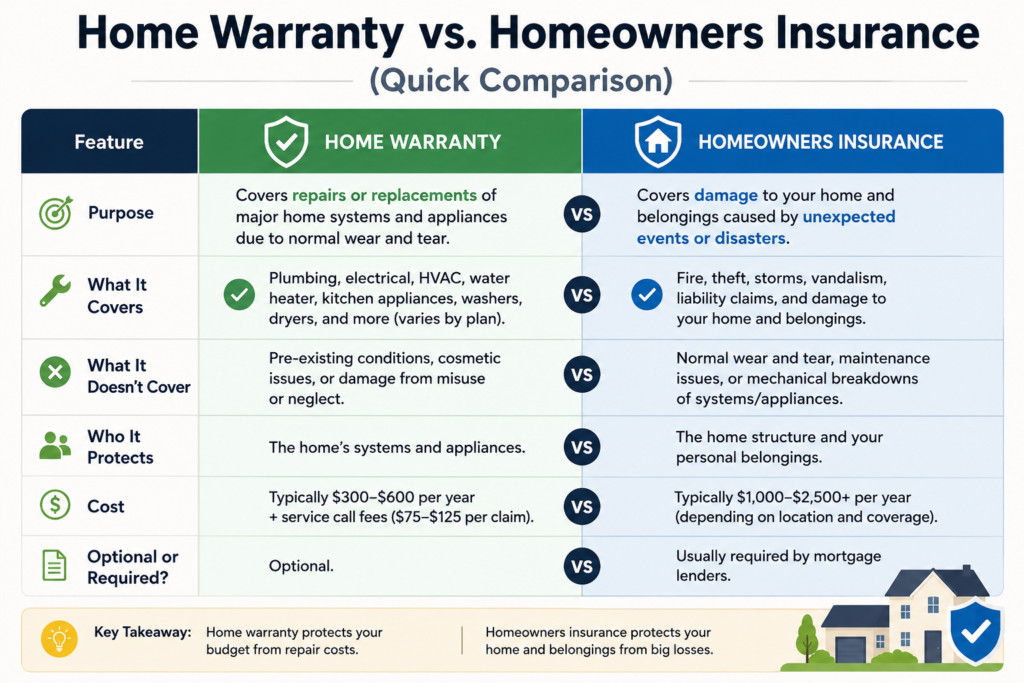
| Home Warranty | Homeowners Insurance | |
|---|---|---|
| Covers | Mechanical failure from normal wear | Damage from fire, storms, theft, disasters |
| Required by lender? | No | Usually yes |
| Typical annual cost | $350 – $750 | $1,200 – $2,000+ |
| Claim payment | Repair/replacement via provider’s network | Cash payout or reimbursement |
Frequently Asked Questions
Is a home warranty the same as a manufacturer’s warranty? No. A manufacturer’s warranty is included free with a new appliance and covers defects for a limited time (often 1–2 years). A home warranty is a paid annual contract you purchase separately, covering many items at once regardless of brand or age (within reason).
Can I choose my own repair technician? Generally no. Home warranty companies dispatch technicians from their own approved network. Some providers offer a “self-schedule” option for an added fee, but this isn’t standard across the industry.
Do home warranties cover pre-existing problems? No. Providers require that covered items be in good working condition at the time of enrollment. Anything already broken is excluded.
How long does a home warranty claim take? Most non-emergency claims are scheduled within 24–48 hours of filing, though actual repair time depends on parts availability and technician scheduling. See How Long Does a Home Warranty Claim Take to Process? for a full timeline.
Can I cancel a home warranty if I’m not happy with it? Yes, most contracts allow cancellation, though many charge a cancellation fee and refund only the unused prorated portion of your premium. Details vary by provider — see Can You Cancel a Home Warranty? Refund Policy Explained.
Next in this guide series: Home Warranty vs Homeowners Insurance: What’s the Difference? · How Much Does a Home Warranty Cost Per Month? · Best Home Warranty Companies of 2026 (Ranked & Reviewed)
Leave a Reply